Given our little time remaining in Morocco and our desire to see the wild southern part of the country, we caught the bus from Marakech to Ouarzazate. Getting the bikes on board was surprisingly easy – they had plenty of room and we simply wheeled the bikes into the luggage compartment and tied them to a support.
The bus route was spectacular, if a little nausea inducing, winding through narrow valleys and over the high Atlas Mountains. Between the long bus ride and the week off the bikes, by the time we arrived in Ouarzazate, we were both well and truly pining for the open road, physical exertion and the contentment that comes with tired legs and hunger at the end of the day.
Ouarzazate was much nicer than we expected. It’s really clean, has a Kasbah and a square that had a market in full swing with motorised kiddie cars buzzing around. It’s also home to Morocco’s film industry with two studios here. You can see why, because the surroundings are spectacular with the high Atlas Mountains forming a dramatic backdrop to the arid landscape surrounding the town.
We camped the night in a palmery (an oasis of palms) complete with mud brick walls, shady date palms (of course) and a bubbling fountain. For us, it was paradise after the chaos of Marrakech.
We set off bright and early for Agdz. The road was sparsely populated, had very few vehicles and was absolutely beautiful, with stunning high desert scenery. It’s been a while since we’ve had such an awesome day of cycling and it made us remember why we enjoy it so much.


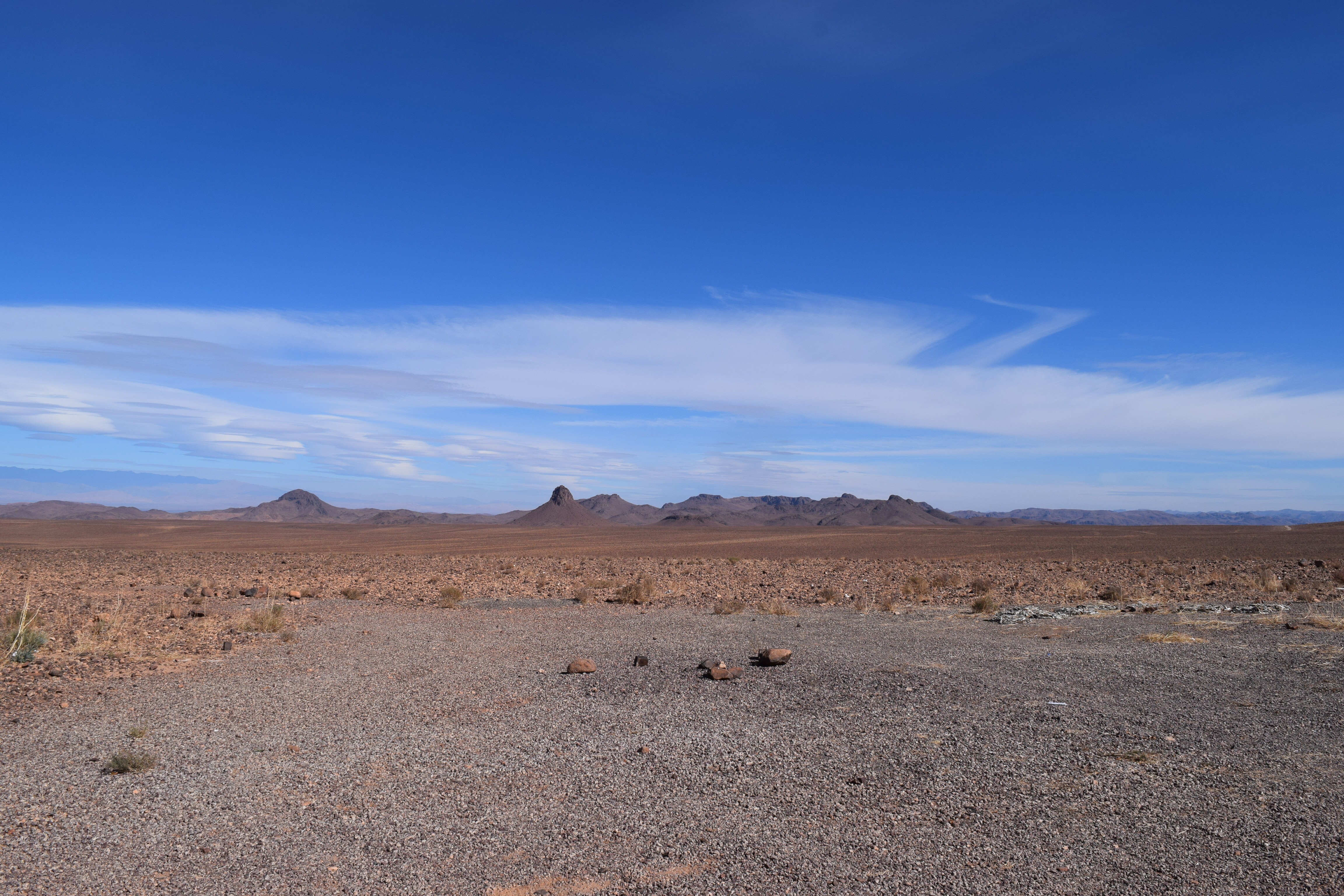
We stopped for a Berber omelette (a tajine of eggs with tomato and spices) in a roadside cafe in the middle of nowhere. It was delicious and we got to sit outside in a covered tent with cushions and a low table – a welcome relief from the glaring sun).

Towards the end of the day we reached the top of the pass and got our first glimpse of the Draa with its green palms, and irrigation providing a stark contrast to the desolate desert scenery all around. A quick descent had us in Agdz by 4pm and ready to find a camp for the night.


As soon as we stopped to get our bearings we were pretty much swamped by locals wanting to sell us camel rides, carpets and jewellery. We’d managed to politely decline the offers, when we were approached by Ali who very politely asked if I could write him a letter in English to his Australian friend. Of course I said yes, and we soon found ourselves in a friends shop, drinking mint tea. A few minutes later we were both clad in turbans and were being shown some rather beautiful jewellery! The sell was very good natured though and we both bought a turban (which we’ve now worn every day since they provide such good sun protection).

We camped in another palmery (we could get used to this) set amongst a mud brick village and huge Kasbah. It was run by a really lovely French lady and her Moroccan husband, and was really peaceful, complete with birdsong and even a hooting owl or two.
We planned to leave at dawn the next day since we’d read that camp sites were scarce on the 100 km route from Agdz to Zagora. We needn’t have worried about setting an alarm though since the call to prayer was broadcast at a rather early 5 am (two hours before sunrise) and then again every 15 minutes or so from the nearby mosque.
We were off 1/2 an hour after sunrise (a record for us) and were soon cycling though the Draa valley proper.
The Draa valley is fed by the Draa river, Morrocco’s largest river system, which has supported populations for thousands of years. It’s rather impressive with immense date palm plantations and small scale horticulture. Today their are around 225,000 people living in the valley, largely still in mud brick villages.

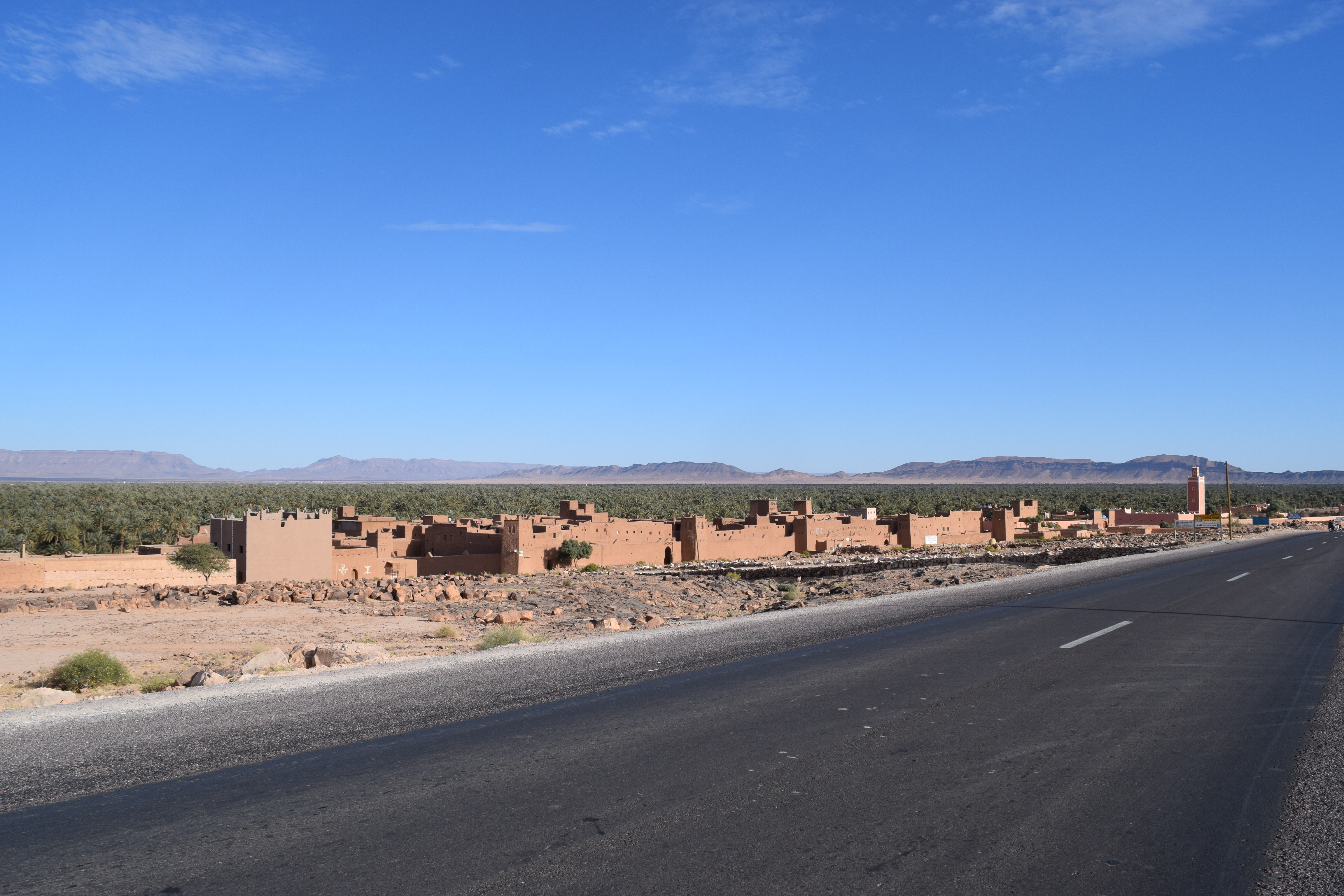
I was astounded (and probably slightly obsessed) by how the local population have built such a large civilisation out for the desert using mud, stones and straw. Some of the mud brick buildings are four or five stories high, with intricate carvings and sometimes even painted. We passed mud brick huts, hotels, kasbahs and even large and grand hotels.


The Draa river snakes along though high cliffs and open plain providing a narrow strip of green amongst the harsh and stony desert country. The road itself winds in and out of the irrigated areas and, as a result is heavily populated along much of the way.
For us, this provided some really good and some trying moments. The good was the generally good natured honking and thumbs up from drivers, the waves from children and the occasional hello from people on the side of the road. The bad was the constant harassment. At one time I was mobbed by children and physically pulled off the road. They demanded sweets and when I refused, got a little hostile, pulling at my panniers and ripping the visor off my helmet.
We met a Belgian couple cycling in the opposite direction soon after. They had been cycling in Morocco for a month, and like us, while finding most people really lovely, had also had an occasional run in, the worst being people throwing large rocks at them from the hills above. Apparently some other locals stopped it all before it got messy, but yikes!
We entered Zagora in the late afternoon, passing heavily armed police at the boundary. Of course it wasn’t long before we had our first offer of a carpet shop browse and a hotel room (one guy talked to us out of his car window as he was driving – when we didn’t slow down, he pulled in front of us and braked quickly to force us to stop). We’ve already found ourselves getting better at dealing with these offers. We’ve found a very firm but good natured “Laa Shukran” and even a made up story or two (such as we can’t follow you because we are meeting friends) really helps. Once the initial bartering stage is over, the locals have been helpful and are quite happy to point you in the direction of the market or campsite you’re actually after.
Our campsite (the oasis palmier) may be the best camp site we’ve ever stayed at. We were shown a shady site, provided a large straw mat for the tent, and a rug, table and chairs to sit around. The next day we got a full breakfast delivered right to our tent door!

 4ks an hour